
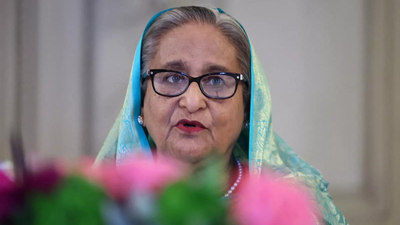
A Bangladesh court on Monday sentenced former prime minister Sheikh Hasina to a total of 10 years in prison in two separate corruption cases linked to alleged irregularities in the allocation of residential plots under the Purbachal New Town government project near Dhaka.According to news agency ANI, Dhaka Special Judge Court-4 handed Hasina five years’ imprisonment in each case, taking the total sentence to 10 years.
Ex-PM Hasina Calls Yunus “Murderous Fascist,” Warns Bangladesh at Edge of AbyssThe verdict was delivered by Judge Robiul Alam.In the same cases, Hasina’s niece Tulip Rizwana Siddiq, a British MP and daughter of Sheikh Rehana, was sentenced to two years in each case, totalling four years in prison.Another niece, Azmina Siddiq, and Hasina’s son Radwan Mujib Siddiq, also known as Bobby, were sentenced to seven years’ imprisonment each.
Details of the verdict and accused
Only one of the accused, a senior Rajuk official, was present in court, while the rest were tried in absentia.“The trial of the accused was not obstructed regardless of where they (accused) were in the world,” the judge said while delivering the verdict, as quoted by PTI.
Background of the cases
The Anti-Corruption Commission (ACC) filed the cases on January 13, 2025, initially against 16 individuals, later submitting charge sheets against 18 accused on March 10, 2025.A total of 31 witnesses testified during the trial, with the recording of testimonies concluding on January 5 this year. The court had fixed February 2 for pronouncing judgment in both cases.The corruption watchdog alleged Hasina colluded with government officials to illegally secure plots in the Purbachal New Town Project for herself and her family members, despite them being ineligible under existing rules.Hasina has earlier been convicted in multiple other cases related to the same project and sentenced to a cumulative 26 years in prison in previous verdicts.
Reactions and political context
Hasina’s now-disbanded Awami League described the sentences as “entirely predictable” and alleged the cases were “fabricated” by the interim government led by Nobel laureate Muhammad Yunus.Tulip Siddiq rejected the allegations, calling the process “flawed and farcical from the beginning to the end”. “I’m absolutely baffled by the whole thing,” she was quoted by the BBC as saying, adding that she had not received any summons or charge sheet.She said she had engaged lawyers in both the UK and Bangladesh.Sheikh Hasina has been living in exile in India since August 5, 2024, after her government was toppled in a student-led uprising.Following her ouster, an interim government under Muhammad Yunus initiated a series of legal proceedings against Hasina, her family members and former Awami League leaders.Earlier, a special tribunal sentenced Hasina to death on charges of committing crimes against humanity for her alleged role in brutally suppressing the student-led uprising.Separately, on an Anti-Corruption Commission complaint, a court on November 27 had sentenced Hasina to a total of 21 years’ imprisonment.
